


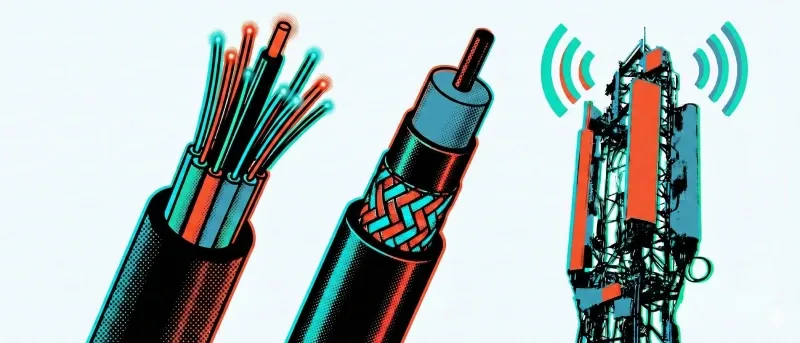
Fiber vs. cable vs. 5G internet: Which one should you actually get?
If you’re moving, setting up a home office, or finally upgrading a painfully slow internet connection, you’ve probably fallen into the fiber vs. cable vs. 5G internet rabbit hole. Welcome! We’ve put this guide together to help you climb out and get on your way. By the end, we hope you’ll feel confident about which internet is best for you—fiber vs. cable internet vs. 5G—and be totally equipped to place an order you’ll be happy with.
Contents
The quick answer: fiber
Want the TL;DR version? Here’s the fastest way to decide between fiber vs. cable vs. 5G internet:
- Check if fiber is available.
- If fiber is available, compare plans and pick the best deal.
- If fiber isn’t available, decide on 5G home internet vs. cable based on pricing, upload needs, or reliability.
Why check fiber first?
Fiber is almost always better than cable and 5G home internet. Here’s why.
- Fastest top speeds. Fiber speeds commonly reach 1 Gig to 5 Gigs, with 10 Gbps emerging.
- Symmetrical speeds. Fiber provides equal upload and download speeds for smoother backups, video calls, and gaming.
- Unmatched reliability. Fiber is far less sensitive to weather, network congestion, and electrical interference compared to copper and wireless connections.
- Futureproof. The infrastructure can scale for decades without replacing the physical lines.
Comparing the three technologies
Fiber, cable, and 5G all use completely different delivery systems to get you online—and that’s not just nerdy trivia. The technology affects lots of the factors you probably care about as you evaluate fiber vs. cable vs. 5G internet, from availability to speeds and even pricing. Below, we break it all down to help you understand your options.
Fiber internet, explained
Fiber vs. 5G and cable internet
How it works. Fiber transmits data using pulses of light through strands of glass thinner than a human hair. The signal doesn’t degrade across the same kinds of electrical noise that affect copper in cable networks, so fiber vs. cable internet is exceptionally fast and stable.
Availability. Fiber is expanding quickly, especially in cities and newer suburbs, but can still be hit-or-miss in populated areas. It’s generally unavailable in rural areas.
Speed. Fiber plans typically offer speeds of 300 Mbps–5 Gbps, with some areas seeing 8–10 Gbps rollouts. Unlike cable, fiber can actually sustain these speeds under load. Plus, fiber has the advantage of easily providing symmetrical speeds, where uploads are just as fast as downloads—a major win for anyone who works all day with cloud tools, uploads large files, or needs consistent two-way speeds for video calls and gaming.
Reliability. Fiber optics, vs. cable internet, are highly resistant to signal interference, network congestion, and most weather-related disruptions. Fiber also offers consistently low latency, often in single-digit milliseconds, which means faster response times for gaming, video calls, and other real-time applications, even during peak hours.
Typical sticker price. Fiber generally runs $50–$100 per month depending on speed tier and region.
Installation. Fiber often requires professional installation, since it’s a newer service and many homes don’t have an existing connection to the local fiber network. Most providers can schedule you within a few days, but it’s never guaranteed.
Recommended uses. Fiber is great for large households or power users, work-from-home setups, competitive gamers, content creators, complex smart homes, and anyone thinking long term about which internet is best.
Cable internet, explained
Cable vs. fiber and 5G home internet
How it works. Cable providers send internet signal over copper coaxial cables originally used for TV. This is the main reason for the differences between cable vs. fiber internet speeds and reliability—copper signals just aren’t as “clean” or high-capacity as fiber.
Availability. Cable is often the default option where fiber hasn’t been deployed yet, except in rural areas, where wired infrastructure remains scarce due to the limited potential for subscribers.
Speed. Cable plans usually offer 100–1,200 Mbps, with some markets offering 2,000 Mbps or even more—on the download, anyway. Remember that with cable (vs. fiber) internet speeds, you could be getting 1,000 Mbps down but only 20–35 Mbps up. This impacts solo tasks like photo shares, video uploads, and data backups, as well as interactive functions like video calls, gaming, and all-day communication with cloud tools.
Reliability. Cable internet is generally reliable, but performance can vary because of the copper in the network. During peak usage hours, speeds may slow and latency can increase, which is most noticeable during online gaming or video calls. While cable is less sensitive to weather than wireless options, it doesn’t offer the same consistency or low-latency performance as fiber.
Typical sticker price. Cable plans run about $40–$90/month and can be substantially more expensive at the fastest speeds.
Installation. Self-installation is a common option for cable internet because most homes have at one point been connected to the local cable network. For new home builds, professional installation will be required.
Best recommended use. Cable works well for many people and is the best choice where fiber isn’t available. Streamers, browsers, casual gamers, and households that mainly download content will be happiest with the service.
5G home internet, explained
5G home internet vs. fiber and cable
How it works. With 5G and other cellular wireless internet services, your home router connects to a nearby cell tower. It’s the same way your phone connects to mobile data, but with hardware tuned for use at a fixed location.
Availability. Wireless home internet doesn’t have the same geographical restrictions as cable/fiber, so in more rural areas it’s a strong alternative to satellite. Ironically, availability in urban areas can fluctuate because providers limit sign-ups to preserve performance.
Speed. Typical speeds run 40–300 Mbps, or sometimes even higher, but exact speeds depend heavily on your distance to the tower and on network congestion. Be aware too that especially in rural areas, wireless providers often utilize 4G speed bands to improve stability and access, since 5G towers have a shorter range.
Reliability. Reliability is the biggest difference when comparing 5G home internet vs. cable or fiber. Wireless network performance fluctuates significantly more than wired internet, based on distance from the tower, network congestion, and weather. Latency runs higher than wired services but is still relatively low at 20–50 ms, though spikes can happen.
Typical sticker price. Cellular 5G home internet runs about $50–$70/month.
Installation. Usually, 5G home internet is self-install only. Providers mail you a gateway that plugs into a standard power outlet and connects wirelessly to a nearby 5G tower. Setup then takes just a few minutes, with no drilling, wiring, or technician visit required.
Best recommended use. Wireless 5G/4G home internet is best for light-to-moderate internet use, daily browsing, casual gaming or streaming, and video calls, especially in rural areas without wired alternatives.
Compare fiber vs. cable vs. 5G internet at a glance
Which internet is best? Here’s an overview of how they compare.
Fiber internet | Cable internet | 5G home internet | |
|---|---|---|---|
How it works | Light signals through fiber-optic glass | Coaxial copper cables | Signal from 5G cell towers (and often 4G) |
Availability | Urban and suburban | Urban and suburban | Urban to rural |
Typical download speeds | 300–5,000+ Mbps | 100–1,200+ Mbps | 40–300 Mbps |
Typical upload speeds | 300–5,000+ Mbps | 5–50 Mbps | 5–25 Mbps, but highly variable |
Latency | 2–10 ms | 15–30 ms | 20–50+ ms |
Network performance | Very consistent | Consistent | Unpredictable |
Typical sticker price | $50–$100/month | $40–$90/month | $50–$70/mo |
Installation | Professional install | Professional or self-install | Self-install |
Recommended use | Remote work, 4K streaming, competitive gaming, large households, smart homes, content creators | Gaming, HD streaming, gaming, video calls, everyday browsing, remote work | Everyday browsing, social media, casual gaming and streamin |
Shopping guide
By now, you probably have a preference on getting fiber vs. cable vs. 5G internet. As you move to the step of actually ordering new service, Movearoo is here to help with a small hub of major nationwide partners and key tips on how to choose an internet provider and plan. Let’s get started.
1. Check availability of top providers
The first step when shopping is to see what’s actually available at your address—because the best internet plan on paper doesn’t help if it doesn’t reach your home.
Below are the top fiber, cable, and 5G internet providers nationwide, with links to our partners. Visit any provider websites you’re interested in and enter your ZIP code or address to see available plans. If a provider doesn’t serve your area, close out that tab, then come back to this article for help navigating the options you have left.
Fiber providers—check these first
- Google
Cable providers
- Cox
- Optimum
- Spectrum
- Xfinity
5G home internet providers
- T-Mobile
2. Look for these things while shopping
Once you find available fiber vs. cable internet and 5G plans, it’s time to get more granular. Sticker price and download speed are usually the first things you’ll see, but we recommend looking a little closer to maximize your chances of becoming a satisfied customer.
If you don’t see the following information advertised plainly, look for it in the fine print or in the Broadband Facts panel, a federally regulated feature that lists essential characteristics of an internet plan. (They look similar to the Nutrition Facts panels on packaged food.)
- Upload speeds & latency. As we covered earlier, these metrics will give you an idea of how fast your upload activities will be and how responsive your service will feel overall.
- Data use. Most fiber and cable plans offer unlimited data, but 5G home internet may have soft caps that slow your speeds after you use a certain amount of data.
- Introductory rate. The sticker price might be an introductory rate that expires after a year. Look in the fine print or Broadband Facts to see how long the advertised rate lasts and what it changes to.
- Equipment fees. Your modem/router lease rate may be included in the sticker price, but not always.
- Installation & other one-time fees. Professional installation may cost around $100 for standard installs, while self-install is often free or just enough to cover shipping. Activation and other fees are less common than they used to be, but double-check the Broadband Facts.
- Bundles, deals, and other offers. Multi-service bundles are common in internet service and might come with discounts on at least one of the included services. You can also look for one-off promotions on equipment, such as deals on new phones when you bundle mobile service.
- Contracts. Fewer plans require contracts these days, but some still do. Make sure to note the contract length and any cancellation fees.
- Trial periods. Although rare, risk-free trials are sometimes available, allowing you to speed test your actual vs. advertised speeds and decide whether you made the right choice. If a trial period isn’t available, though, speed testing can still help you troubleshoot with tech support or negotiate plan changes with customer service.
Frequently asked questions
Top queries on fiber vs. cable vs. 5G internet
Which internet is best?
The best internet for new homes and old depends on what’s available at your address and how you use the internet. Fiber is usually the top choice for speed and reliability, especially for streaming, gaming, and working from home; cable offers strong performance for most households; and 5G home internet works well for everyday use where fiber and cable aren’t available.
How do I know if an internet service is fiber vs. cable vs. 5G internet?
Fiber and 5G providers will usually state outright what kind of provider they are. Cable providers typically don’t, but popular providers in the US include Cox, Optimum, Spectrum, or Xfinity.
Is fiber internet better than cable?
In most cases, yes. Fiber offers faster upload speeds, more consistent performance during peak hours, and better long-term scalability. Cable internet is still fast and reliable, but its upload speeds are lower, latency is higher, and performance can vary more when many people in your area are online simultaneously.
Should I get fiber or cable internet?
If you can get fiber, choose it—especially if you work remotely, upload large files, or have a busy smart-home setup. Cable is the next-best option and is perfectly suitable for typical streaming, browsing, and gaming. Availability is the deciding factor for most households.
Is fiber internet worth it?
Fiber internet is the best-performing internet on the market for speed and reliability, and prices are comparable to cable and 5G—sometimes even lower than cable at similar speed tiers. If you need fast or symmetrical upload speeds for large file shares, backups, or video calls, you’ll likely be happier with fiber. Ultimately, whether fiber is worth it depends on your budget and what features you care about most.
Is 5G home internet good?
Yes. For many households, 5G home internet can make a strong, affordable alternative to cable because it’s fast enough for streaming, browsing, and remote work. However, speeds can fluctuate day to day and over time based on distance from nearby 5G towers, network congestion, and even weather. For more reliability, choose a wired service—heavy uploaders or competitive gamers may prefer fiber over cable.
How fast is 5G home internet?
Most 5G home internet plans deliver 100–300 Mbps, though speeds can exceed 1 Gbps in strong coverage areas. Actual performance depends on your location, signal strength, and network traffic.
What’s the difference between fiber vs. cable upload speeds?
With fiber, upload speeds are symmetrical with (equal to) download speeds—often running 500 Mbps to 1 Gbps or more. Cable upload speeds are much lower, typically 10–35 Mbps, because cable networks prioritize download bandwidth. If you upload large files, join video calls all day, or work in the cloud, fiber’s upload performance makes a noticeable difference.
Final verdict on fiber vs. cable vs. 5G internet
When it comes to fiber vs. cable vs. 5G home internet, the best choice is about matching the technology to your home and how you actually use the internet.
If fiber is available, it’s the clear winner. Fiber vs. cable internet offers the fastest speeds, the strongest upload performance, and the most consistent reliability, making it the best long-term option for remote work, gaming, smart homes, and busy households. It’s also the most futureproof choice, with infrastructure designed to handle higher speeds for years to come.
If fiber isn’t available, cable internet is usually the next best option. Cable delivers fast download speeds that easily handle streaming, gaming, and everyday use, and it’s widely available across the US. The tradeoff is slower upload speeds and occasional slowdowns during peak hours—drawbacks that matter more for heavy uploaders than casual users.
If wired options are limited, 5G/4G home internet is a strong alternative. It’s fast enough for most daily tasks and easy to set up. While it doesn’t match fiber or cable for consistency, cellular networks offer a practical solution for renters, rural areas, and households that prioritize convenience.